
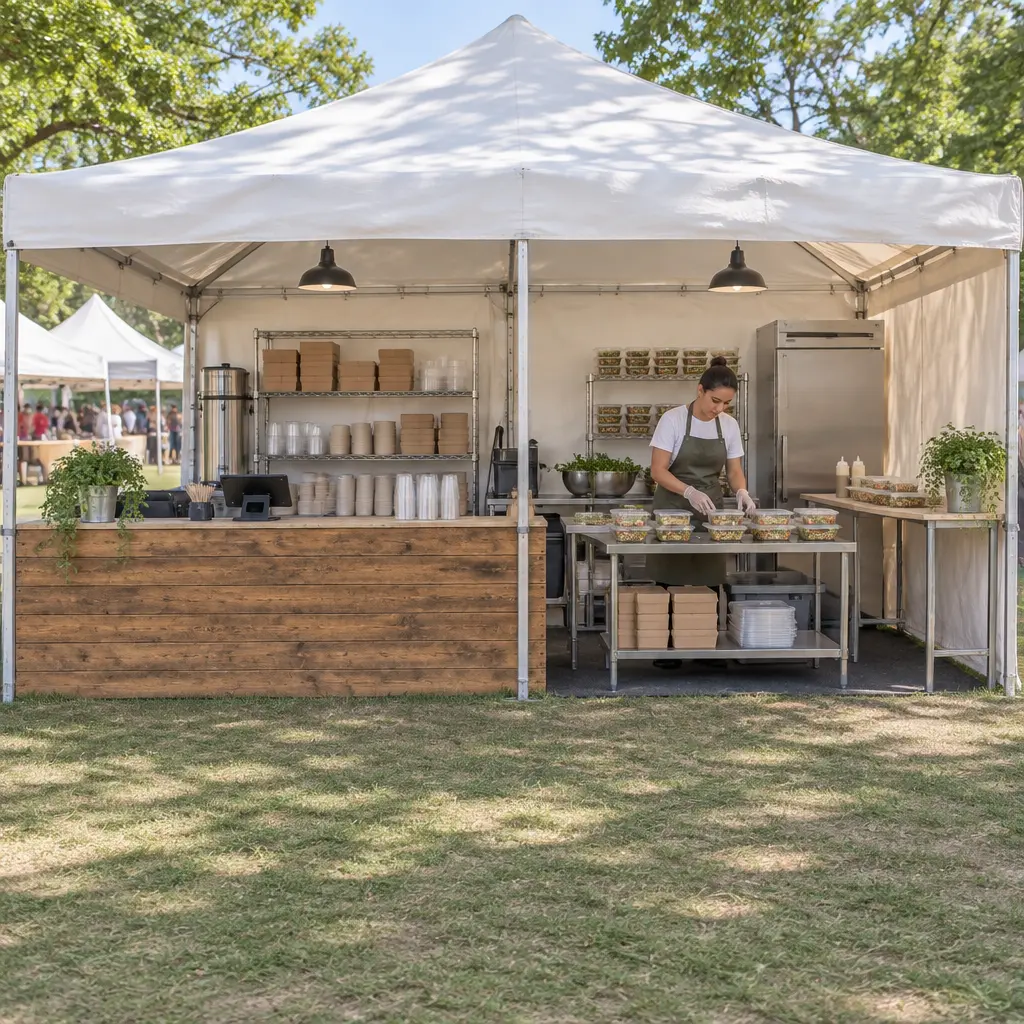
Festival food booth menu design is the deliberate selection and presentation of items to serve customers quickly, safely, and profitably under crowded, temporary-event conditions. A high-volume menu prioritizes a small number of familiar, batch-preparable dishes, shared ingredients, clear ordering choices, and a service line that separates ordering from pickup. This approach matters because every extra choice or made-to-order step can slow a queue, while safe temperature control and adequate staffing remain essential: the U.S. Food and Drug Administration’s Food Code calls for cold time/temperature-control-for-safety food to be held at 41°F (5°C) or below and hot food at 135°F (57°C) or above. The sections below translate those constraints into menu architecture, item selection, pricing, workflow, food safety, and practical performance measures.
Menu Simplicity: the foundation of festival booth service speed
A service-speed menu is a deliberately limited set of offerings designed around the booth’s equipment, staff skills, demand pattern, and replenishment capacity. The National Restaurant Association’s industry research describes persistent operator pressure from labor and operating costs; for a temporary booth, reducing unnecessary preparation and decision points is a practical way to protect throughput. Simplicity does not mean offering only one food. It means making each option fast to understand, assemble, and hand over.
Useful menu-design hyponyms include a core-item menu, a modular menu built from shared components, and a combo-led menu that bundles popular items. These structures can be combined: a booth might sell two core entrées, one vegetarian alternative, and a small set of drinks and sides, with most items drawing from the same prepared ingredients.
Core-item menu: fewer choices, faster decisions
A core-item menu puts a short list of high-demand, quick-to-finish foods at the center of the offer. Each additional choice can require more signage, ingredient storage, staff training, and customer explanation. Keep the main board scannable: name the item, show its price, and state only the distinctions that affect a purchase, such as protein, spice level, or vegetarian status.
For example, a booth could offer a grilled chicken wrap, a vegetable wrap, and a shared side. Before the event, test the menu against expected demand and production capacity rather than assuming that a broad selection will attract more sales. The National Restaurant Association’s consumer and industry research is useful for identifying broad dining preferences, but local event history and preorders are more directly relevant to a particular festival.
Modular menu: shared ingredients reduce complexity
A modular menu uses a common set of ingredients in several combinations. One batch of cooked protein, for instance, might fill a bowl or a wrap, while the same vegetables and sauce support both. This reduces the number of distinct ingredients that must be ordered, stored, labeled, and replenished. It can also make the menu more resilient if one component sells faster than expected.
Shared ingredients are not a reason to overlook allergen controls. The FDA identifies nine major food allergens in the United States: milk, eggs, fish, crustacean shellfish, tree nuts, peanuts, wheat, soybeans, and sesame. Clearly document which menu items contain them, prevent cross-contact where feasible, and train staff to route ingredient questions to a designated, knowledgeable person.
Combo-led menu: simplify ordering and payment
A combo-led menu groups a popular entrée with a side or drink at a stated price. Bundles reduce the number of decisions at the register and can make the average transaction more predictable for production planning. Display the bundle prominently, but retain an easy way to buy the entrée alone so customers with different appetites or budgets are not forced into a larger order.
Use clear names and fixed combinations rather than open-ended customization. If an event uses cashless payment, confirm connectivity, backup payment procedures, and the location of the payment terminal before opening. Payment methods and local event rules vary, so validate those details with the organizer.
Menu Engineering: matching food choices to production capacity
Menu engineering is the process of comparing an item’s popularity and contribution margin so the operator can decide what to promote, adjust, or remove. In a festival booth, the analysis should also include finish time, station demand, holding quality, and ingredient overlap. A high-margin item is not a good operational choice if it ties up the only grill during the rush or deteriorates rapidly while held.
The key categories are operationally efficient bestsellers, profitable but under-promoted items, low-demand items that consume scarce capacity, and signature items worth retaining for brand value. Track actual sales and preparation issues during service, then revise the menu after the event rather than relying on memory alone.
Batch-friendly items: prepare ahead, finish quickly
Batch-friendly foods can be prepared in controlled quantities before the peak and finished or portioned rapidly when ordered. Examples include pre-portioned ingredients for bowls, pre-cooked proteins reheated using an approved method, and baked goods prepared before service. Choose items that retain acceptable texture and temperature during the expected holding period.
Batching shifts work away from the order window, but it does not remove food-safety obligations. The FDA Food Code provides model provisions for safe cooking, cooling, reheating, and holding; local health departments adopt and enforce applicable requirements. Confirm the jurisdiction’s rules, approved equipment, and any permit conditions before designing the production plan.
Assembly time and station load: design around the bottleneck
Assembly time is the elapsed time needed to complete an order after its components are ready. Station load is the amount of work assigned to each position, such as grilling, assembling, taking payment, or handing out food. A booth’s practical throughput is constrained by its slowest step, so adding menu items that depend on that station can reduce total output even when other staff are available.
Run a timed rehearsal with realistic staffing and equipment. Record order-to-handoff time, items produced per 15-minute interval, remakes, and the point where a queue begins to grow. If grill capacity is the constraint, shift demand toward pre-cooked or cold-assembled options where permitted; if payment is the constraint, simplify choices and separate ordering from pickup.
Ingredient overlap and inventory: protect availability
Ingredient overlap means that multiple menu items use the same components. It can reduce waste and simplify purchasing, but excessive dependence on one ingredient can create a single point of failure. Use sales forecasts, event attendance information, and past consumption to estimate starting quantities, then set a replenishment threshold for key ingredients.
The U.S. Department of Agriculture’s FoodKeeper guidance offers storage and food-quality information for many foods. For event operations, combine such guidance with supplier instructions, local health requirements, and a written inventory log. Keep backup stock organized so replenishment does not interrupt the customer-facing line.
Service-Line Design: turning the menu into a fast handoff
Service-line design is the arrangement of people, equipment, ingredients, and customer movement so each order follows a clear path. A well-designed menu cannot deliver speed if customers block the pickup area, staff cross paths, or the same worker must repeatedly leave the assembly station for supplies. The National Institute for Occupational Safety and Health’s ergonomics guidance supports arranging work to reduce unnecessary reaching, carrying, and repetitive strain—useful principles for compact booth layouts.
Common service configurations include a single queue, separate order-and-pickup points, and a production line with specialized stations. The best choice depends on site dimensions, fire and accessibility rules, expected demand, and the event organizer’s layout requirements.
Order and pickup separation: reduce crowding
Separate order/payment from pickup when space and staffing allow. Customers should be able to understand where to join the queue, where to pay, and where to wait without asking staff. Use large, high-contrast signs and avoid placing the pickup point directly in the path of customers who are still deciding.
A simple order-number or name-calling system can reduce handoff confusion. Test it during rehearsal, especially in a noisy environment. The Americans with Disabilities Act applies to public accommodations, including many event food services; coordinate with the organizer to ensure accessible routes, counters, and customer service arrangements comply with applicable requirements.
Station specialization: assign clear roles
Station specialization assigns repeatable tasks to defined positions—for example, one person takes orders, one assembles food, and one manages finishing and pickup. Clear roles reduce duplicated work and make it easier to train temporary staff. A cross-trained employee can cover breaks or respond to a surge, but the normal workflow should still identify who owns each task.
Use short verbal calls or printed tickets to communicate order details. Keep utensils, packaging, napkins, and condiments at the point of use. During a rush, avoid adding complicated custom requests unless the food-safety and production process can handle them consistently.
Packaging and handoff: finish orders without delay
Packaging is part of the production system, not an afterthought. Select containers that are easy to open, suitable for the food’s temperature and moisture, and fast to fill. Pre-stage approved packaging, labels, napkins, and utensils, while keeping them protected from contamination and weather.
The U.S. Environmental Protection Agency’s food-waste resources encourage prevention and better management of discarded food. Right-sized portions, accurate forecasting, and packaging that preserves food quality can support both service speed and waste reduction. Check local rules on disposable foodware, recycling, and composting before ordering supplies.
Food Safety: keeping fast service controlled
Food safety is the set of practices that prevent foodborne illness during receiving, preparation, holding, and service. Speed must never depend on skipping temperature checks, handwashing, cleaning, or allergen controls. The FDA Food Code is a model used by state and local regulators; operators should follow the version and requirements adopted by their own jurisdiction.
Relevant control categories include time and temperature control, hand hygiene and sanitation, and allergen communication. These controls should be designed into the menu and workflow before the event begins.
Temperature control: monitor high-risk foods
Time/temperature-control-for-safety foods require controls because pathogens can grow under unsuitable conditions. The FDA Food Code specifies cold holding at 41°F (5°C) or below and hot holding at 135°F (57°C) or above in its model provisions. The Code also includes cooking and cooling requirements that depend on food type and process, so consult the applicable local rules rather than treating holding limits as a complete safety plan.
Use calibrated thermometers, keep temperature logs, and assign a named employee to check and record temperatures. Set up cold storage and hot-holding equipment before receiving ingredients, and establish a corrective action for readings outside the permitted range.
Sanitation and hand hygiene: build controls into the setup
Sanitation includes cleaning and sanitizing food-contact surfaces at the required intervals, preventing contamination between raw and ready-to-eat foods, and maintaining an accessible handwashing station where required. The Centers for Disease Control and Prevention identifies handwashing as an important measure for preventing illness; gloves do not replace handwashing or proper glove changes.
Before opening, verify potable water, wastewater handling, soap, paper towels, sanitizer, test strips, and waste containers. Keep chemicals away from food and food-contact items. Local temporary-food permits may specify equipment and operating procedures, so review inspection requirements with the health authority well in advance.
Allergen communication: make answers reliable
Allergen communication means giving customers accurate information about ingredients and cross-contact risks. Maintain a written ingredient and allergen matrix for each menu item, including sauces, toppings, and packaged products. Avoid promising an item is allergen-free unless the process can reliably support that claim.
Train staff to pause and consult the designated ingredient information instead of guessing. When an order requires special handling, define whether the booth can safely accommodate it; if not, communicate that limitation clearly. A concise menu can make allergen information easier to maintain, but only if recipes and supplier ingredients are documented.
Pricing and Measurement: balancing speed, margin, and demand
Pricing and measurement connect the menu’s commercial performance with its operational performance. A booth should track not just revenue, but also contribution margin, order volume, preparation time, stockouts, waste, and customer wait. Event conditions can vary sharply by hour, weather, and program schedule, so measure results in short intervals where practical.
Useful performance indicators include orders per 15 minutes, median order-to-handoff time, percentage of orders completed within a chosen target, average transaction value, food cost per item, and discarded or unsold portions. No single benchmark fits every event; compare results against rehearsal capacity and the booth’s own prior performance.
Price architecture: make choices clear
Price architecture is the way prices and bundles are arranged to guide customer decisions. Use legible, consistent prices and avoid a structure that requires staff to calculate numerous add-ons during a rush. Price items from current ingredient, packaging, labor, permit, and event costs, then confirm that the expected selling price is acceptable to the target audience.
The U.S. Bureau of Labor Statistics’ Consumer Expenditure Surveys provide context on household spending, but they are not a substitute for local event research. Compare nearby vendors, test customer response where possible, and review actual sales mix after the event. Make sure displayed prices and any required taxes or fees follow local disclosure rules.
Demand forecasting: prepare for peaks, not averages
Demand forecasting estimates how many portions will be needed at different times. Festival traffic is uneven: headline performances, meal periods, weather changes, and event entry surges can create short peaks that an all-day average hides. Use the organizer’s attendance estimates, prior event records, weather outlook, and nearby programming to plan staffing and batch sizes.
A practical visual is a 15-minute sales-and-throughput chart, with forecast demand compared against actual orders and production capacity. The chart can reveal whether a queue grows because demand exceeds capacity, a station is underperforming, or an item mix is consuming too much equipment time. Adjust batches and staff positions using observed results while preserving safe holding limits.
Waste and stockout tracking: refine the next event
Waste and stockout tracking records what was discarded and what customers could not buy. High waste may indicate overproduction, poor holding quality, or weak demand; repeated stockouts may indicate underforecasting or an unbalanced menu. Record quantities by item and time, then revise purchasing and batch schedules.
A simple post-event review should compare forecast to actual sales, identify the slowest station, note customer questions, and document equipment or supply failures. Keep the menu stable enough to learn from one event to the next, changing only the items or procedures supported by evidence.
Conclusion: a menu built for speed is a complete operating system
Festival food booth service speed depends on more than a short menu. Menu simplicity reduces decisions; menu engineering aligns popularity and margin with production capacity; service-line design clarifies movement and roles; food-safety controls protect customers; and measurement improves forecasting, pricing, and waste management. The FDA Food Code’s temperature benchmarks, CDC hand-hygiene guidance, and local permit requirements provide essential guardrails for fast service.
Start with a focused menu, time every item in a realistic rehearsal, map the customer and food flow, and assign staff ownership for safety checks. After the event, use sales, wait-time, waste, and stockout records to refine the next service. For further planning, review the current local temporary-food rules and the FDA Food Code provisions applicable to your operation.
Sources: U.S. Food and Drug Administration, Food Code 2022, https://www.fda.gov/food/fda-food-code/food-code-2022; U.S. Food and Drug Administration, Food Allergies, https://www.fda.gov/food/food-labeling-nutrition/food-allergies; National Restaurant Association, Research and Reports, https://restaurant.org/research-and-media/research/; Centers for Disease Control and Prevention, About Handwashing, https://www.cdc.gov/clean-hands/about/; U.S. Department of Agriculture, FoodKeeper App, https://www.foodsafety.gov/keep-food-safe/foodkeeper-app; National Institute for Occupational Safety and Health, Ergonomics and Musculoskeletal Disorders, https://www.cdc.gov/niosh/ergonomics/; U.S. Environmental Protection Agency, Preventing Wasted Food at Home, https://www.epa.gov/recycle/preventing-wasted-food-home; U.S. Bureau of Labor Statistics, Consumer Expenditure Surveys, https://www.bls.gov/cex/; U.S. Department of Justice, ADA Requirements: Effective Communication, https://www.ada.gov/resources/effective-communication/.