
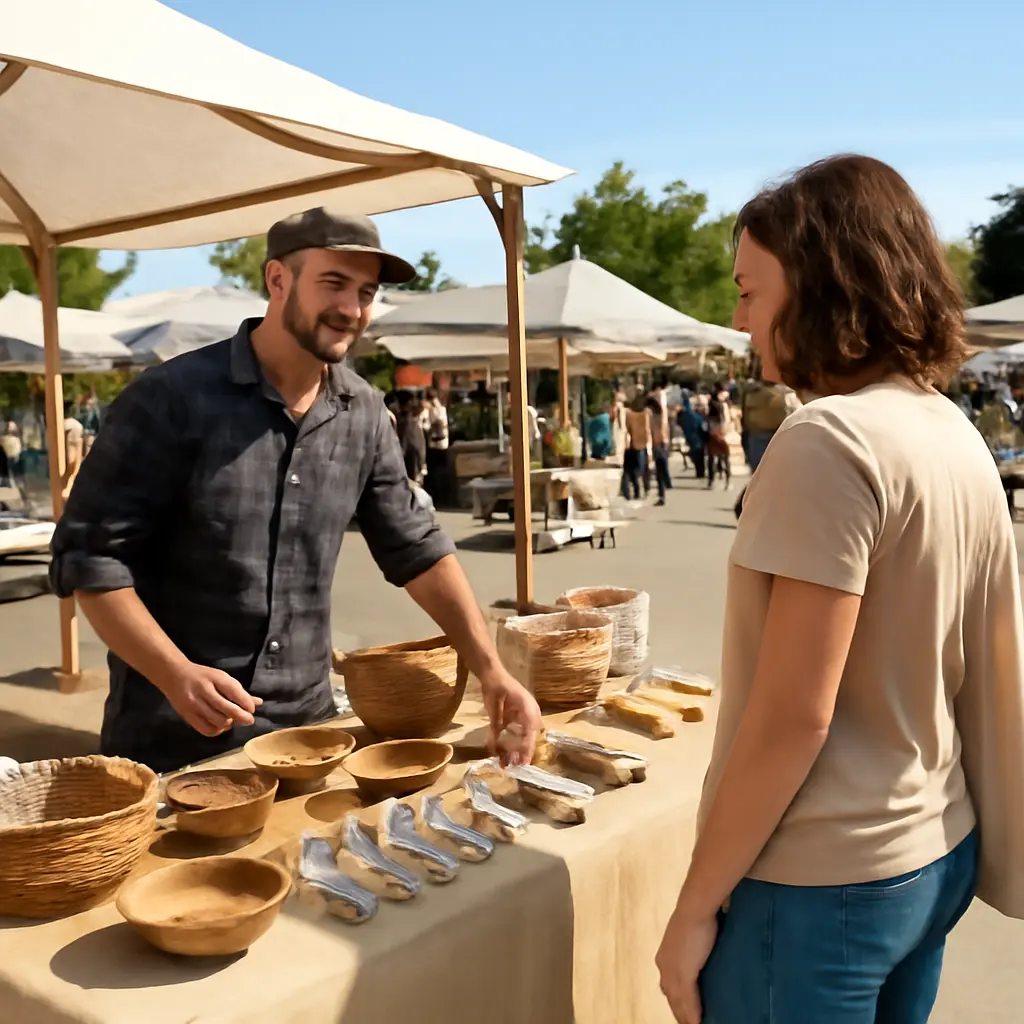
Festival booths are temporary retail spaces where vendors sell products directly to attendees while introducing a brand to a concentrated, experience-seeking audience. Their financial value goes beyond the day’s sales: a well-run booth can also generate customer leads, product feedback, social content, and repeat purchases. The opportunity is substantial but not automatic. The National Independent Venue Association has documented the economic importance of live events to local businesses, while event-industry research consistently identifies attendee engagement and on-site spending as key parts of the live-event experience. For vendors, the practical question is how to balance immediate revenue with longer-term brand building—and how to measure both.
Festival booths combine direct sales with brand building
Direct sales are transactions in which a business sells to consumers without relying on a separate retailer as the seller. At a festival, that usually means the vendor displays merchandise, explains the offer, accepts payment, and delivers the product on site. The U.S. Federal Trade Commission describes direct selling broadly as selling products directly to consumers outside a fixed retail establishment, though event booths may also be subject to venue, local licensing, and consumer-protection rules.
Brand building is the deliberate work of shaping recognition, associations, trust, and preference for a business. The American Marketing Association defines a brand as a name, term, design, symbol, or other feature that identifies one seller’s goods or services and distinguishes them from competitors. A festival booth brings these two activities together: each transaction can produce revenue, while the interaction, display, packaging, and follow-up can make the brand more memorable.
This distinction matters because booth performance cannot be judged by gross sales alone. A booth that breaks even on the day may still create profitable customer relationships, while a high-revenue booth can lose money after fees, inventory, travel, labor, and payment-processing costs. The relevant measures are therefore both immediate and downstream.
Direct-to-consumer booth sales
Direct-to-consumer, or DTC, sales occur when a brand sells to the end user itself. At festivals, common formats include product sampling followed by purchase, limited-edition merchandise, food and beverage sales, and demonstrations that let customers test an item before buying. The short path between maker and customer gives vendors direct control over pricing, presentation, and customer service, while also exposing them to the costs and logistics of selling in person.
The U.S. Census Bureau’s quarterly e-commerce reports provide a useful comparison point: online sales account for a significant share of U.S. retail, but physical events give shoppers a chance to see, touch, taste, or discuss products before purchasing. A festival booth can complement online sales rather than replace them by turning an in-person interaction into an online reorder or referral.
Experiential marketing at festivals
Experiential marketing uses a live interaction or activity to help people experience a brand rather than encounter it only through advertising. A booth might offer a tasting, customization station, mini-workshop, photo opportunity, or product demonstration. The activity should make the product easier to understand or remember; entertainment without a clear connection to the brand can attract a crowd without producing meaningful sales or qualified leads.
Event-marketing studies by organizations such as Event Marketer have reported that consumers value live brand experiences and that marketers use events to support awareness and engagement. Results vary by audience and research method, so vendors should treat such findings as directional rather than a guarantee. Their own conversion rate, customer feedback, and post-event sales are stronger evidence of what works for a particular booth.
Festival booth economics determine the real money
Festival booth economics are the relationship between event-generated revenue and the full cost of participating. A basic calculation is contribution after event costs: sales revenue minus product costs, booth fees, permits, travel, lodging, labor, equipment, payment fees, and other event-specific expenses. This is more informative than looking at cash collected because it distinguishes sales volume from profit.
The U.S. Small Business Administration advises business owners to account for both fixed and variable costs when assessing profitability. For a festival vendor, a booth fee is typically a fixed event cost, while inventory and transaction fees rise with sales. Before booking, estimate a break-even point: the sales required to cover event costs, adjusted for the gross margin on each product.
Break-even sales and contribution margin
Contribution margin is the amount left from a sale after variable costs are deducted. If a product sells for $30 and costs $12 to make and package, its contribution before payment fees and event overhead is $18. If the booth, travel, and labor total $900, the vendor would need to sell 50 such units to cover those costs, assuming no other variable expenses. This is an illustrative calculation, not a general festival benchmark.
A practical forecast should use several scenarios: conservative attendance and conversion, expected performance, and a strong day. Include product mix, average order value, inventory limits, weather exposure, and hours of operation. The U.S. Bureau of Labor Statistics’ Consumer Expenditure Surveys can help vendors understand household spending categories, but they cannot predict demand at a particular event; local audience fit and past sales are more useful for that decision.
Booth fees, staffing, and operating costs
A booth fee buys access to the event’s selling environment, not guaranteed sales. Costs may also include insurance, electricity, permits, transport, accommodation, signage, display fixtures, food-safety supplies, and staff wages. Festivals may impose requirements for approved vendors, product categories, setup times, and sales reporting, so reviewing the contract and organizer rules is part of the financial analysis.
Labor planning affects both cost and customer experience. A solo operator may save wages but struggle to take payments, restock, answer questions, and manage a queue simultaneously. A second trained person can improve service and capture leads, but should be added only when expected incremental sales or operational reliability justify the expense.
Inventory, pricing, and payment friction
Inventory decisions balance lost sales against unsold stock. Vendors can use prior event sales, seasonal demand, product shelf life, and restocking access to set quantities. A tiered product range—an accessible entry item, a core product, and a premium option—can serve different budgets while making the average transaction easier to grow through bundles or add-ons.
Payment convenience also matters. The Federal Reserve’s 2024 Diary of Consumer Payment Choice found that cash remained a meaningful payment method, while cards and mobile payments were also widely used. A vendor should confirm network coverage, carry a tested card reader, display prices clearly, and keep a compliant cash option when practical. The objective is to reduce checkout friction without assuming every attendee pays the same way.
Brand building turns booth visits into future demand
Brand building at a festival is the process of making the business recognizable, understandable, and worth remembering during a brief encounter. The booth is a compact brand environment: its signage, staff, product quality, packaging, and service all communicate what customers can expect. Consistency matters because a memorable display is most valuable when it accurately represents the product and the company’s later online or retail experience.
The American Marketing Association’s definition emphasizes differentiation. In practical terms, a vendor should make it easy to answer three questions: What is this product? Who is it for? Why choose it over an alternative? A concise sign, a clear demonstration, and a credible reason to believe can make those answers visible even in a crowded setting.
Recognition, storytelling, and product demonstration
Recognition grows when customers repeatedly encounter consistent visual and verbal cues, such as a distinctive color palette, logo, product name, and short brand message. Storytelling can explain the product’s origin, materials, craft, or purpose, but it should be specific and supportable. Demonstrations are especially useful for products whose value is difficult to communicate through packaging alone.
A booth display can be tested like a retail shelf. Put the most recognizable product and clearest benefit where passersby can see them, keep prices legible, and avoid clutter that hides the offer. Track whether people stop, ask questions, sample, and buy; these behaviors help identify where the presentation loses attention.
Lead capture and permission-based follow-up
A lead is a prospective customer who has expressed interest and provided a lawful way to continue the relationship. Vendors can invite visitors to join an email list, follow a social account, enter a clearly explained drawing, or scan a QR code for product information. The value lies in permission-based follow-up, not in collecting as many contacts as possible.
The Federal Trade Commission’s CAN-SPAM guidance requires commercial email to meet rules including accurate sender information, a non-deceptive subject line, a valid postal address, and a functioning opt-out mechanism. Other privacy laws and platform policies may also apply. Explain what people are signing up for, obtain appropriate consent, and send a relevant follow-up while the event is still fresh in their memory.
Social proof and customer-generated content
Social proof is evidence that other people value or use a product. At a festival, it can take the form of customer testimonials, visible demonstrations, genuine user posts, or a popular product being discussed in the queue. Encourage customers to share their experience without making unsupported claims or presenting incentives as independent endorsements.
A simple photo spot or branded backdrop can generate social content, but it should be optional and easy to use. Ask permission before photographing identifiable customers, disclose material connections when promoting endorsements, and avoid implying that an individual customer’s experience is typical unless there is evidence for that claim.
Measurement connects event activity to business results
Festival measurement distinguishes what happened at the booth from what the event contributed to the business afterward. The most useful scorecard combines sales, costs, customer behavior, and follow-up outcomes. It also uses a consistent time window, since event-attributed purchases may occur days or weeks after the festival.
Sales and profitability metrics
Track gross sales, units sold, average order value, product-level margin, refunds, payment fees, and total event costs. A simple event profit estimate is revenue minus the cost of goods sold and event expenses. Compare that result with the forecast and with other sales channels, while noting unusual conditions such as weather, schedule changes, or a different audience mix.
- Break-even units: event-specific fixed costs divided by contribution per unit.
- Average order value: total sales divided by completed transactions.
- Sell-through rate: units sold divided by units available for sale.
- Lead conversion: attributable purchases divided by qualified leads over a defined period.
Brand and customer metrics
Brand outcomes need observable proxies. Count meaningful conversations, samples distributed, opt-in contacts, social mentions, QR-code visits, post-event website traffic, repeat purchases, and customer questions. These measures do not prove that the festival caused every later sale, but they can show whether the booth generated attention and whether the follow-up journey worked.
Use event-specific links, discount codes, or checkout questions to improve attribution, while keeping the process simple for customers. Compare results against a baseline period or a similar event. If a discount code is used, assess whether it created incremental demand or merely shifted purchases that would have happened anyway.
A practical example of combined returns
Consider a small maker selling handmade skincare at a weekend festival. The vendor tracks booth expenses and product margins, offers samples, and invites interested visitors to join a product-education email list. Day-one sales show whether the booth covered its immediate costs; later, code-based online orders and repeat purchases help estimate the value of the new customer relationships. The example illustrates why a business should report same-day profit separately from estimated customer lifetime value, rather than treating a projected future purchase as cash already earned.
Planning and compliance protect the opportunity
A strong festival plan begins with audience fit, not booth aesthetics. Review the event’s attendance profile, competing vendors, product restrictions, site layout, weather exposure, and cancellation terms. Ask organizers about expected foot traffic and previous vendor experience, but treat attendance estimates as estimates rather than guaranteed buyers.
Permits, safety, and accessibility
Requirements differ by location and product. Food vendors may need health permits, safe-temperature controls, ingredient and allergen information, and inspections; sellers of other regulated products may face separate labeling or licensing rules. The U.S. Food and Drug Administration provides food-labeling and allergen guidance, while state and local authorities determine many operational requirements. Confirm rules with the organizer and relevant agencies before committing.
Accessibility is also part of effective booth design. Keep paths clear, make essential information readable, consider counter height and reach, and provide staff who can communicate clearly with visitors. The U.S. Department of Justice’s Americans with Disabilities Act guidance explains accessibility obligations for businesses and public accommodations; vendors should consult applicable requirements rather than assume the festival site handles every responsibility.
Post-event learning and repeatability
After the event, reconcile sales records, inventory, expenses, leads, and customer feedback. Note which products sold, which displays drew attention, when traffic peaked, and what customers asked before purchasing. Use that information to adjust pricing, stock, staffing, signage, and the choice of future events.
The most valuable outcome may be a repeatable event model: a clear audience, reliable operating costs, a booth layout that converts, and a follow-up process that turns contacts into customers. A vendor should scale only after comparing several events or testing meaningful variations; one unusually busy weekend is not enough to establish a dependable forecast.
Conclusion: direct sales and brand building work best together
Festival booths can produce immediate transactions and longer-term brand value, but the real return depends on disciplined economics and deliberate follow-up. Direct-to-consumer sales provide control and customer contact; experiential marketing makes the product tangible; brand building supports recognition and preference; and measurement shows whether the event generated profit, leads, or repeat demand. Booth fees, inventory, labor, permits, and payment costs must be included before declaring an event successful.
Before booking, calculate break-even sales, verify the audience fit, and set targets for both revenue and customer engagement. During the festival, make the offer easy to understand and checkout simple. Afterward, compare actual results with the forecast and contact opted-in leads responsibly. Vendors who treat each booth as both a sales channel and a measurable brand experiment are better positioned to discover where festival participation creates durable business value.
Sources: American Marketing Association, “The Definition of Marketing” and “Branding,” https://www.ama.org/the-definition-of-marketing-what-is-marketing/; U.S. Federal Trade Commission, “Direct Selling,” https://www.ftc.gov/business-guidance/industry/direct-selling; U.S. Census Bureau, “Quarterly Retail E-Commerce Sales,” https://www.census.gov/retail/ecommerce.html; U.S. Small Business Administration, “Break-Even Point,” https://www.sba.gov/business-guide/plan-your-business/calculate-your-startup-costs; U.S. Bureau of Labor Statistics, “Consumer Expenditures,” https://www.bls.gov/cex/; Federal Reserve Financial Services, “2024 Diary of Consumer Payment Choice,” https://www.frbservices.org/news/research/2024-findings-from-the-diary-of-consumer-payment-choice; Federal Trade Commission, “CAN-SPAM Act: A Compliance Guide for Business,” https://www.ftc.gov/business-guidance/resources/can-spam-act-compliance-guide-business; U.S. Food and Drug Administration, “Food Allergies,” https://www.fda.gov/food/food-labeling-nutrition/food-allergies; U.S. Department of Justice, “ADA Requirements: Effective Communication,” https://www.ada.gov/resources/effective-communication/; National Independent Venue Association, “NIVA Reports,” https://www.nivassoc.org/reports; Event Marketer, “EventTrack,” https://www.eventmarketer.com/.